







You've likely seen gaming headsets marked "7.1 surround sound." However, what precisely is it, and does it actually affect gaming? In this guide, we'll break down how 7.1 surround sound works, whether it actually improves gaming performance, and when it might (or might not) be worth using.
Table of Contents
- What Is 7.1 Surround Sound?
- How Does 7.1 Surround Sound Work in Gaming Headsets?
- Virtual 7.1 vs Physical 7.1 Surround Sound
- Does 7.1 Surround Sound Actually Help in Games?
- Why Do Some Gamers Dislike Virtual 7.1?
- 7.1 vs Stereo: Which Is Better for Gaming?
- Who Should Use a 7.1 Gaming Headset?
- What to Look for in a 7.1 Gaming Headset?
- Akko Verge S9 Ultra 7.1 Gaming Headset
- Final
- FAQ
What Is 7.1 Surround Sound?
7.1 surround sound is a multi-channel audio technology, delivering a more immersive listening and gaming experience by using precise sound field positioning to give sound direction, distance, and a sense of depth in three-dimensional space.
7.1 = 7 speakers+1 subwoofer.
7: There are seven main independent audio channels
- Front Left & Right: Deliver the main stereo audio.
- Center Channel: Handles dialogue and central sound cues.
- Side Left & Right: Add depth to sounds from the sides.
- Rear Left & Right: Reproduce sounds coming from behind.
1: One low-frequency effects channel.
7.1 Surround Sound Applications
Home Theater: These channels are played through multiple speakers placed around the listener. By distributing sound across these different positions, the system can reproduce a 360-degree sound environment, allowing listeners to hear audio cues from the front, sides, and behind them.
Cinema: By adding rear surround channels, Dolby 7.1 surround sound improves positional audio, making gaming more immersive and assisting players in finding sounds.
Esports Gaming: Audio cues are equally as important as visual cues in competitive games. 7.1 surround sound gives players a tactical advantage in high-intensity games by assisting them in identifying the direction of gunfire, footsteps, and other important sounds.
So, how about the 7.1 surround sound work in a gaming headset? Is it truly set up like a professional studio with seven main channels and one low-frequency effects channel? Let's check!

How Does 7.1 Surround Sound Work in Gaming Headsets?
Actually, most gaming headsets rely on the virtual 7.1 surround sound technology to achieve multiple audio channels. Because there are only two earcups (left and right) and cannot reproduce true multi-channel surround sound.
The core mathematical model is the HRTF (High-Resolution Audio Frequency) to achieve the virtual 7.1 surround sound. It models how sound waves interact with the human head and ears before reaching the eardrum. Our ability to locate sound sources comes from small differences in how sound reaches each ear. A sound from the left arrives slightly earlier and louder in the left ear, while sounds from behind may be partially blocked by the head. HRTF models these differences as algorithms, allowing headphones to recreate realistic spatial direction and enable virtual surround sound.
Gaming headsets' 7.1 surround sound first collects or presets a large amount of HRTF data, then applies this data to the game's audio signal, delaying, filtering, and adjusting the gain of the left and right channels to simulate the sound propagation differences of 7 surround channels + 1 low-frequency channel. This allows the brain to automatically fill in the gaps in the multi-channel spatial perception after receiving the binaural signals.
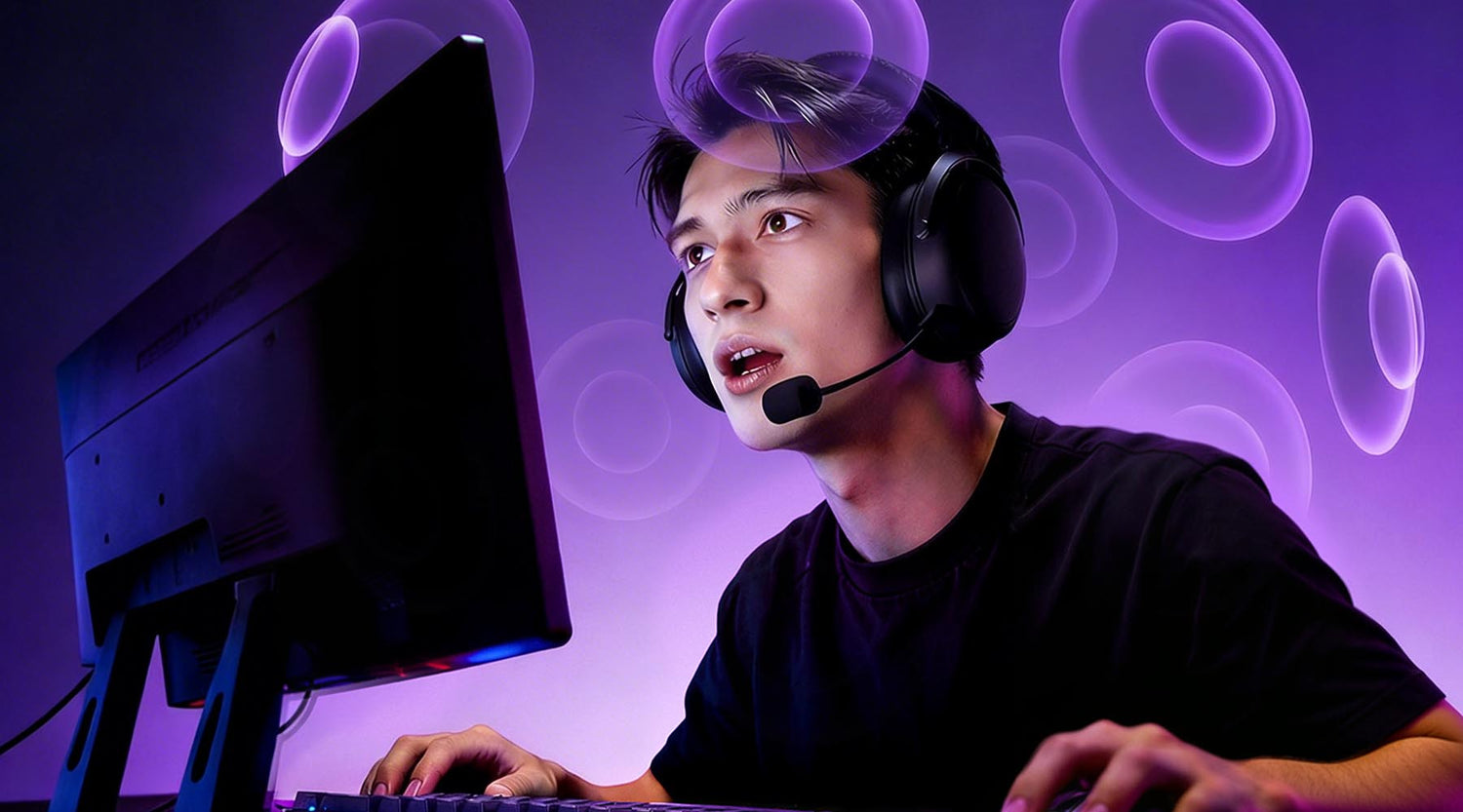
Virtual 7.1 surround sound uses algorithms to simulate a multi-speaker setup, allowing even a small gaming headset to deliver directional audio for footsteps, gunshots, and other in-game cues.

Next, let's look at the difference between virtual 7.1 and true 7,1 surround sound.
Virtual 7.1 vs Physical 7.1 Surround Sound
| Comparison Dimension | Physical 7.1 Surround Sound | Virtual 7.1 Surround Sound |
| Core Principle | Multiple drivers inside each earcup (usually 4–5) reproduce different channels physically. | Algorithm-based simulation using two drivers and spatial audio processing such as HRTF. |
| Channel Implementation | Physical separation: front, side, rear, and subwoofer signals are output by separate drivers. | Psychoacoustic simulation: algorithms create directional cues that the brain interprets as surround sound. |
| Sound Characteristics | High theoretical separation, but multiple drivers in a small space may cause interference and unnatural sound. | Smooth and coherent soundstage with stable positioning, though digital processing may slightly affect pure audio fidelity. |
| Sound Positioning | Strong in theory, challenging in practice due to tuning complexity and driver interference. | Accurate and consistent positioning, often optimized for key gaming sounds like footsteps and gunshots. |
| Comfort | Heavier design due to multiple drivers and complex internal structures. | Lightweight and comfortable, similar to standard stereo headsets, suitable for long sessions. |
| Price & Availability | Very expensive and rare, with limited commercial products. | Widely available and affordable, covering entry-level to premium gaming headsets. |
| Software Control | Limited flexibility, as sound characteristics depend on hardware layout. | Highly customizable via software (EQ, virtual channels, footstep enhancement, etc.). |
| Best For | Audio enthusiasts interested in experimental multi-driver designs. | Most gamers, especially FPS and competitive esports players. |
This is why most modern gaming headsets rely on virtual 7.1 surround sound rather than physical multi-driver designs. Because most gaming headsets rely on virtual 7.1, the following sections refer primarily to virtual 7.1 surround sound.
Does 7.1 Surround Sound Actually Help in Games?
There are a lot of different voices about whether the 7.1 surround sound really helpful in games. Now let's explain it.
1. For Competitive Games: Useful
In games like PUBG, Call of Duty: Warzone, CS: GO, or Valorant, the benefits of virtual 7.1 surround sound become very clear.
Hear More Information: 7.1 surround sound helps you build a complete 360-degree spherical sound field. You can clearly distinguish whether a sound is coming from upstairs at a 45-degree angle to your left or from a 90-degree angle to your right. This allows you to predict the enemy's position in advance.
Distance Judgment: Through algorithms simulating sound volume and reverberation, you can hear whether footsteps are 10 meters or 30 meters away, thus deciding whether to prepare to scope in or continue lying in wait.
Practical Significance: In many FPS games, sound often reveals the enemy's position earlier than visuals. A good 7.1 surround sound system is like giving you "perky ears," providing a competitive advantage.
2. For Immersive Single-player AAA Titles: Helpful, But Secondary
In story-driven games like Cyberpunk 2077, Red Dead Redemption 2, and The Last of Us, 7.1 surround sound enhances the atmosphere:
Environmental Realism: Hear subtle audio details, like raindrops hitting different surfaces, campfires crackling behind you, or distant creatures growling—making the game world feel alive.
Cinematic Depth: Cutscenes and sweeping soundtracks gain extra depth, while low-frequency effects like explosions and collisions feel more impactful.
However, for these games, graphics, narrative, and gameplay usually take priority. 7.1 surround sound is a nice bonus—without it, you can still enjoy most of the experience.

Why Do Some Gamers Dislike Virtual 7.1?
You may find that there are some gamers who don't recommend 7.1 surround sound. There are some reasons:
1. Poor Implementation in Some Headsets or Software
Not all virtual 7.1 systems are created equal. If the gaming headset's algorithm quality is not good, the sound is muddy, boomy, or less precise, especially in games that don’t rely heavily on directional cues.
2. Some Games Are Already Optimized for Stereo
Many modern games already include their own advanced spatial audio systems, such as binaural audio or built-in positional sound engines.
When virtual 7.1 is layered on top of these systems, it can sometimes double-process the audio, which may result in distorted positional cues, inconsistent sound positioning, and unnatural soundstage.
3. Misconceptions
Many gamers expect 7.1 surround sound to replicate real-world audio perfectly. In reality, it’s a technical simulation. While it can provide directional cues, the sound is digitally processed and compressed, so it cannot achieve the audio quality of the real world.
4. Personal Preference and Listening Habits
Everyone has their own listening habits. Some gamers simply find stereo sound more natural and easier to interpret, especially if they have spent years playing with traditional stereo headsets.
7.1 vs Stereo: Which Is Better for Gaming?
Stereo audio uses two channels—left and right—to reproduce sound. Even with only two channels, stereo can still provide a strong sense of direction because our brains naturally interpret subtle differences between the sounds reaching each ear.
Now let's check the comparison between the 7.1 surround sound and stereo sound:
| Comparison Dimension | Virtual 7.1 Surround Sound | Stereo Sound |
|---|---|---|
| Technical Principle | Uses the HRTF algorithm to convert dual-channel audio into a simulated multi-directional sound field, creating a 3D spatial effect through software processing. | Traditional dual-channel audio reproduced through two drivers. No spatial algorithm processing; sound is presented in a simple left-right sound field. |
| Spatial Awareness | Simulates multiple directions (front, rear, left, right, and vertical cues), creating a stronger sense of space and immersion. | Mainly provides left-right directional cues with limited spatial depth. |
| Sound Positioning | Can enhance environmental awareness and directional perception in immersive games. | Provides clean and accurate sound signals without processing, helping maintain precise positioning in competitive games. |
| Hardware Requirements | Most gaming headsets support it through software or a USB sound card; no physical multi-channel hardware is required. | Works with virtually all audio devices, including standard headphones and laptop speakers. |
| Compatibility | Performance depends on game support and algorithm quality. Some games may not fully utilize virtual surround sound. | Universally compatible with all games and platforms, with no additional drivers required. |
| Latency & Performance | Software processing may introduce slight latency depending on the implementation. | Minimal processing means extremely low latency and stable performance. |
| Cost | Usually slightly more expensive than comparable stereo headsets but cheaper than physical 7.1 systems. | Very low entry cost; even budget headphones can provide a good stereo experience. |
| Best For | Immersive AAA games like Cyberpunk 2077, open-world exploration, and watching movies where environmental audio enhances immersion. | Competitive FPS games such as Valorant, Counter-Strike: Global Offensive, and PUBG: Battlegrounds, where accurate and latency-free sound cues are critical. |
| Limitations | Performance varies depending on algorithm quality. Poor implementations may cause distortion or inaccurate sound imaging. | Limited spatial depth and immersion, especially in games with complex environmental audio. |
Choose 7.1 Surround Sound when:
- You play demanding 3D games that require strong spatial awareness and frequent enemy location tracking.
- Your headset supports virtual 7.1 surround sound and you’re willing to spend a few minutes calibrating it in the driver software.
- You want a more immersive, cinematic experience when playing story-driven or open-world games.
Choose Stereo when:
- You mainly play 2D games, MOBAs like League of Legends, card games, or simply listen to music and watch videos.
- The game already has a strong built-in audio engine. For example, Counter-Strike: Global Offensive includes its own HRTF system, making stereo the optimal choice.
- Your headset’s virtual 7.1 implementation sounds muddy or unnatural when enabled.
Who Should Use a 7.1 Gaming Headset?
1. FPS / Competitive Gamers
If you mainly play competitive shooters like PUBG: Battlegrounds, Call of Duty: Warzone, Counter-Strike: Global Offensive, Valorant, Tom Clancy's Rainbow Six Siege, or Apex Legends, a 7.1 surround sound headset can be a great choice.
Virtual 7.1 surround sound can help you better identify the direction, distance, and sometimes even the vertical position of enemy sounds. Being able to distinguish whether footsteps come from the front or behind, left or right, can give you valuable reaction time. In fast-paced matches, this situational awareness can help you anticipate enemy movement and gain a tactical advantage.
2. Immersive Single-Player / AAA Game Fans
If you enjoy exploring large, story-driven worlds and want the most immersive experience possible, a 7.1 surround sound headset can enhance the atmosphere.
Representative Games: Cyberpunk 2077, Red Dead Redemption 2, The Last of Us, Horizon Zero Dawn.
These games focus on building a rich and believable world. Virtual 7.1 surround sound helps create a more realistic environment—you can hear rain falling around you, a campfire crackling behind you, or distant footsteps echoing inside a building. This added spatial depth enhances environmental realism and delivers a more cinematic and immersive experience than standard stereo audio.
3. Movie and TV Enthusiasts
While often associated with gaming, 7.1 surround sound headsets can also enhance movie and TV viewing.
Suitable Scenarios: Watching Blu-ray films with surround formats like Dolby Atmos or DTS, or streaming high-quality content on platforms such as Netflix through a computer or game console.
Many movies and streaming titles now include 5.1 or 7.1 surround audio tracks. With a 7.1 headset, sound effects feel more dynamic—you might hear helicopters circling overhead or bullets passing by from different directions. Compared with TV speakers or basic stereo headphones, this creates a far more immersive private cinema experience.
Who Is Not Well-Suited for 7.1 Headsets?
- MOBA Players: Games like League of Legends and Dota 2 focus more on map awareness, strategy, and skill execution than precise sound positioning. Because audio cues are relatively simple, standard stereo headphones are usually more than sufficient.
- Casual or Indie Game Players: Titles such as Stardew Valley and Hollow Knight generally use simple stereo or even mono audio design. In these cases, 7.1 surround sound provides little practical benefit.
- Music-Focused Listeners: If your main goal is listening to music, dedicated Hi-Fi headphones are usually the better choice. Most music is recorded in stereo, and virtual 7.1 processing can sometimes introduce artificial effects or slight distortion, making the sound less natural compared to high-quality stereo headphones.
What to Look for in a 7.1 Gaming Headset?
1. Choose the Virtual 7.1
Physical 7.1 headsets are often bulky, costly, and prone to interference due to their multiple drivers, which can limit sound clarity. In contrast, virtual 7.1 headsets use advanced software algorithms to simulate surround sound, delivering a more precise and practical experience.
2. Focus on Surround Sound Technology
HRTF is the core of the surround sound technology. Some headsets rely on basic virtual surround processing, while others support advanced spatial audio technologies. You can check the product review to get the real experience of the headsets.
3. Check the Driver Size
For gaming headsets, larger drivers (40–60mm) are best. They deliver clearer lows, mids, and highs, create a wider soundstage, and prevent audio from feeling cramped. In FPS games, this feature helps you hear footsteps and gunfire more accurately, thereby improving your positional awareness.
4. Check the Microphone Noise Reduction and Flexibility
In team games, the mic should filter out background noise, such as keyboard clicks or fans, to capture only clear voices for precise communication.
Also, choose a mic that is extendable, bendable, or angle-adjustable so you can position it comfortably without blocking sound or affecting clarity.
5. Prioritize Comfort
For long gaming sessions, go for large, over-ear headsets. Ear pads made of protein leather offer good sound isolation but can become warm, while breathable fabric provides slightly less isolation but keeps you cooler.
6. Check the Connectivity and Platform Compatibility
Confirm that the connectivity can meet your needs. The Wired delivers the lowest latency and the most stable connection, with no need to charge—ideal for competitive gaming and preferred by most hardcore gamers. Wireless options like 2.4G offer more freedom of movement, while Bluetooth tends to have higher latency.
At the same time, you should confirm whether the headphones support multiple platforms such as PCs, laptops, and game consoles.
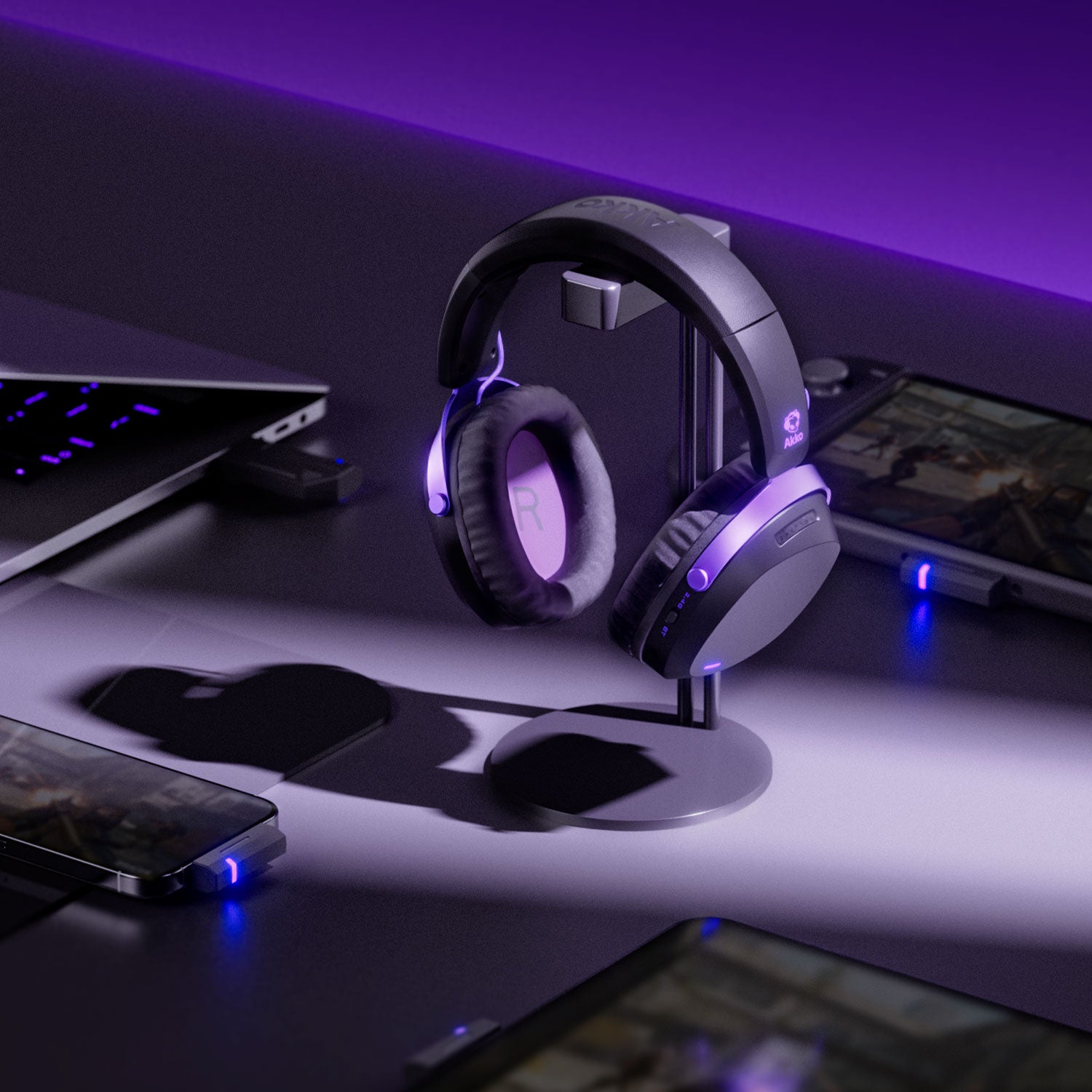
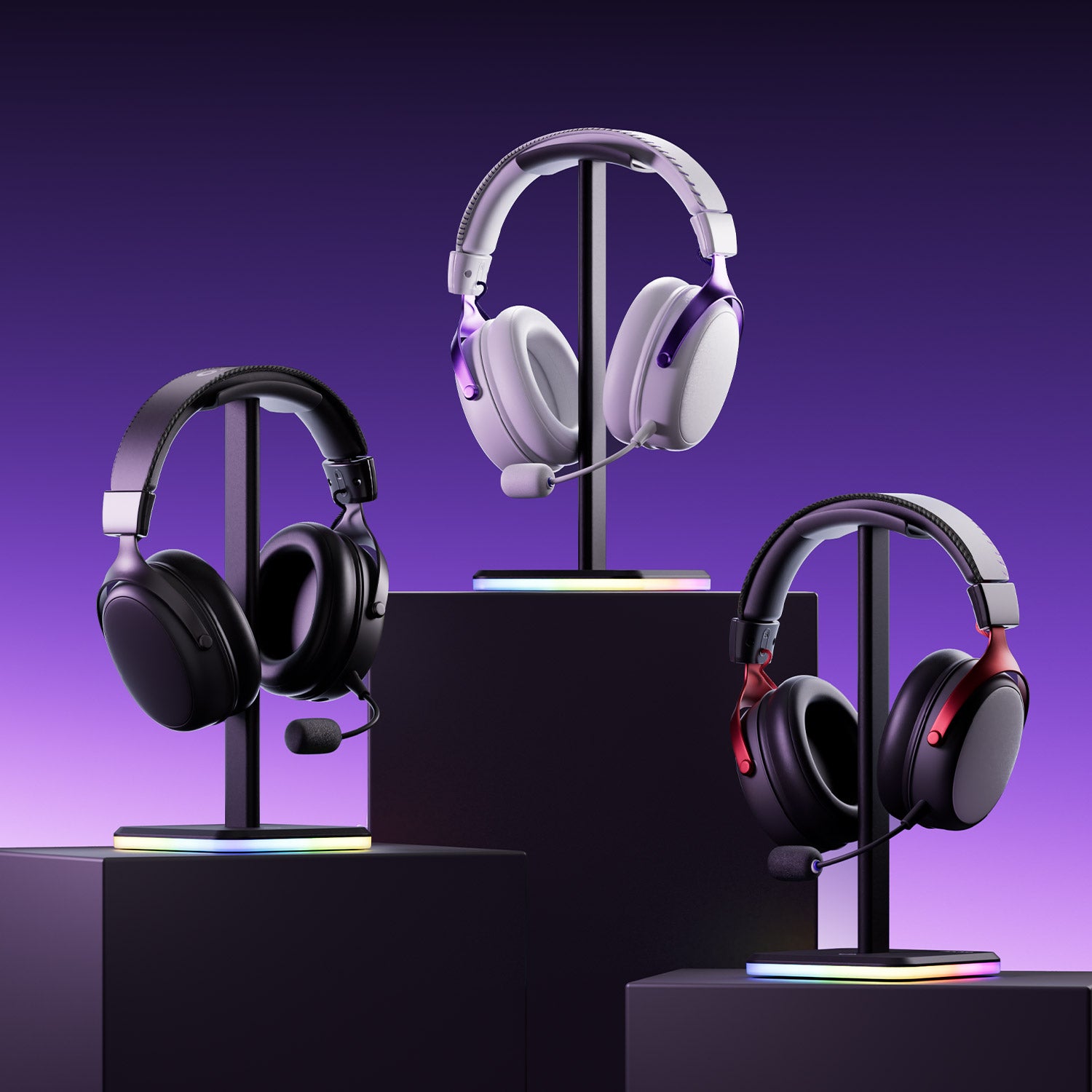
Akko Verge S9 Ultra 7.1 Gaming Headset
53mm N52 neodymium drivers, which deliver stronger magnetic force and faster audio response compared to standard drivers.
With support for 2.4GHz wireless, Bluetooth, USB-A, and USB-C wired connections, Verge S9 Ultra can easily switch between PC, console, and mobile devices. In wireless mode, latency can reach around 15–20 ms, keeping audio closely synchronized with in-game actions.
270 grams, making it relatively lightweight for a wireless gaming headset, and it includes an adjustable headband, travel, and soft ear cushions designed for long gaming sessions.

Akko Verge S9 Ultra Gaming Headset
- 53mm drivers for immersive and balanced sound
- Virtual 7.1 Surround Sound
- Up to a week of usage with the powerful 2000mAh battery
- 2.4GHz wireless connection for low-latency gaming
- Bluetooth 5.3 support for multi-device use
- Compatible with PC, Mac, PlayStation, Switch, and mobile devices
- Lightweight design built for long gaming sessions
Final
So, is 7.1 surround sound actually worth it for gaming? The answer depends largely on your preferences, the games you play, and the quality of the headset you use. A well-designed gaming headset with good drivers, clear positional audio, and comfortable ergonomics will matter far more than whether it simply advertises “7.1 surround sound.” When implemented well, virtual surround sound can enhance immersion and spatial awareness, but it should be seen as one feature among many rather than the deciding factor.
FAQ
Is 7.1 surround sound good for gaming?
Yes, 7.1 surround sound can enhance immersion and spatial awareness in many games. By simulating directional audio cues, it may help players better understand where sounds are coming from within the game world.
Is stereo better than 7.1 for competitive gaming?
Some competitive players prefer stereo audio because it often delivers cleaner sound with less processing. In fast-paced esports titles, clear audio cues can sometimes be easier to distinguish in a well-tuned stereo setup.
Do gaming headsets really have 7 speakers?
Most gaming headsets do not contain seven physical speakers. Instead, they use two drivers and virtual surround sound processing to simulate the effect of multiple audio channels.
Can you use 7.1 surround sound with any headset?
In many cases, yes. Spatial audio technologies such as software-based surround processing can work with standard stereo headphones, though the quality of the effect may vary depending on the hardware and software used.
Does 7.1 surround sound improve footsteps in FPS games?
It can help make directional cues more noticeable, which may make it easier to identify where footsteps are coming from. However, the effectiveness depends on the game’s audio design and the quality of the headset.
Should I always enable 7.1 surround sound?
Not necessarily. Some players prefer to switch between stereo and surround modes depending on the game they are playing. Testing both options can help you determine which setting works best for your playstyle and listening preferences.




Hinterlasse einen Kommentar
Alle Kommentare werden vor der Veröffentlichung geprüft.
Diese Website ist durch hCaptcha geschützt und es gelten die allgemeinen Geschäftsbedingungen und Datenschutzbestimmungen von hCaptcha.